
Parenty - Child Behavior Guide
Camille LabsParenting
4.88.00 Reviews
- Version
- 1.0.61
- Installs
- 10.00K
- Age Rating
- Everyone
Screenshots
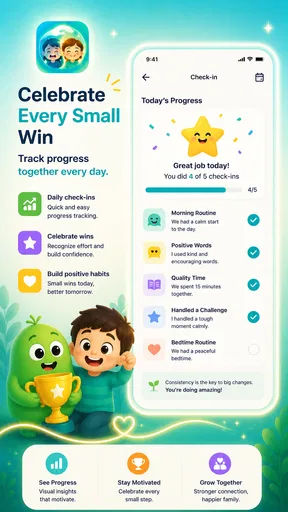
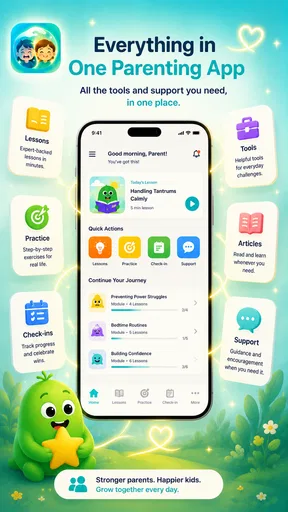
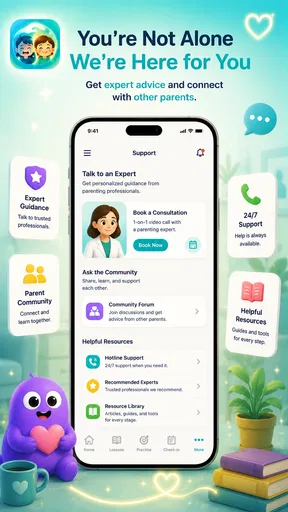
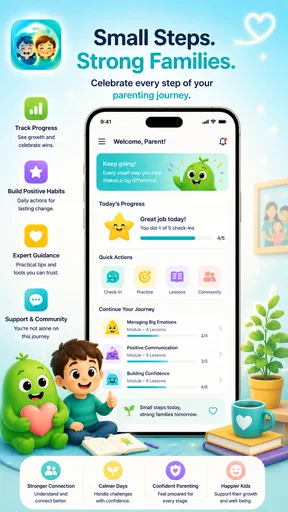
Our Review of Parenty - Child Behavior Guide
 Analysis by Appyee
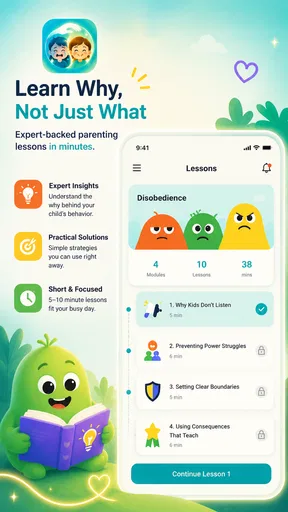
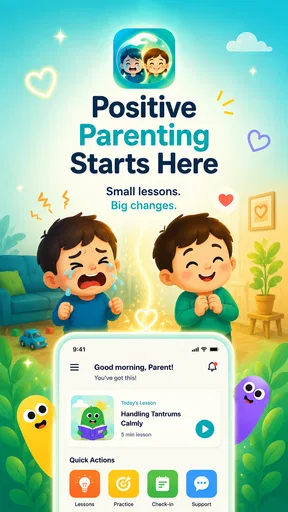
Parenting advice is easy to collect and surprisingly hard to use at the exact moment a child is shouting, refusing, or pushing a boundary. Parenty - Child Behavior Guide takes a more practical route than a shelf of general parenting articles: it is a free parenting app from Camille Labs built around learning, practice, and reflection. I found that focus useful because it turns a difficult interaction into something I can examine instead of simply judging myself or my child.
The app is aimed at parents who want a clearer way to respond to everyday behavior. It is not presented as entertainment for children, and it does not try to replace professional care. Its value is in helping an adult pause, think through a situation, and build a more deliberate response. That makes it especially relevant when the same arguments keep returning and ordinary advice has stopped feeling actionable.
Parenty is available to users aged Everyone, costs nothing to download, and has reached over ten thousand installs. Its average rating is 4.8 from around ninety ratings, with eight written reviews. Those numbers suggest a positive early reception, although I would still treat them as an initial signal rather than proof that every family will find the approach equally useful.
What makes the first week appealing
I’d keep the first week focused on one recurring moment rather than trying to rethink every parenting challenge at once. That gives the learning and reflection a clear purpose, and it makes it easier to notice whether a small change in my response helps. The next question is what could make that focused habit worth keeping.
A calmer starting point for difficult moments
My first impression was that the app’s strongest idea is not a single parenting trick. It is the sequence of learning something, trying to think through it, and then reflecting on what happened. That sequence matters because parenting problems rarely appear as neat questions. A child may be tired, a parent may be rushed, and a small disagreement can become a full confrontation before anyone has chosen a response.
Using a guide in that situation can create a small gap between the trigger and the reaction. I would not expect a lesson to make a tense household instantly peaceful, but a structured prompt can help me notice whether I am trying to teach, punish, negotiate, or simply end the noise. That distinction is one of the more useful takeaways for a parent who tends to improvise under pressure.
The first-week appeal also comes from the low commitment. Because the app is free to start, it is easy to test without treating the download as a major decision. I could explore its approach and decide whether reflective practice fits my personality. Parents who dislike long books, scattered social-media advice, or vague encouragement may appreciate having a more focused place to begin.
Practice is more useful than passive reading
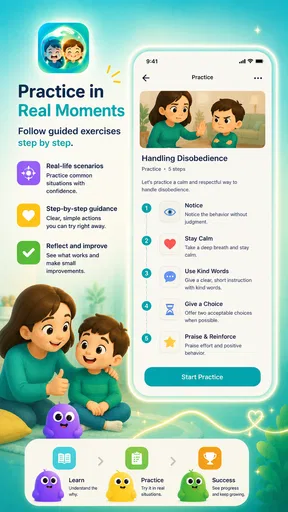
Many parenting resources are consumed like articles: I read a reassuring explanation, agree with it, and then forget it during the next difficult evening. Parenty’s emphasis on practice makes it more promising than a purely informational library. The important question is not whether I understand a principle in the abstract, but whether I can recognize the moment when that principle should guide my words and actions.
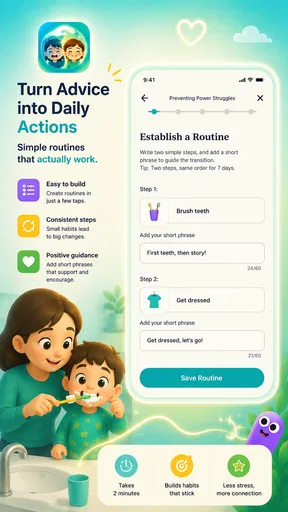
A realistic example would be a child refusing to stop playing before bedtime. Instead of treating the incident as a simple obedience test, I could use the app’s learning-and-reflection approach to examine the transition, my wording, the child’s likely state, and what happened after I responded. The useful result is not necessarily a perfect bedtime. It is a more precise record of what made the exchange escalate or settle.
That kind of review can reveal patterns that are easy to miss. Perhaps the conflict begins whenever instructions arrive without warning. Perhaps I repeat myself so many times that the final request sounds like a threat. Perhaps the child complies but remains upset because the transition feels abrupt. These are practical observations, and they are more valuable than collecting another general slogan about consistency.
Who will benefit quickly
I think the app is best suited to parents who are willing to look at their own part in a behavior cycle. It should appeal to someone who wants a guided way to think, not just a list of commands to give a child. It may also help a parent who has read conflicting advice and needs a calmer framework for deciding what to try first.
It is less suitable for someone seeking an immediate answer to a serious or highly specific situation. A general behavior guide cannot replace an assessment tailored to a child’s development, health, learning needs, or family circumstances. If behavior is dangerous, persistent, or connected to a wider concern, a qualified professional is the better next step. The app can support reflection, but it should not become a reason to delay appropriate help.
Why the value may continue after the novelty
For me, continued value would come from using the app to compare similar situations over time, not from consuming more guidance for its own sake. A brief look back can help separate a genuinely useful adjustment from a one-off good day. That makes the quality of the routine—and how manageable it feels—more important than novelty.
Reflection creates a repeatable parenting habit
The lasting value of Parenty depends on whether I use it after the first burst of curiosity. The novelty of any new app fades quickly, especially in a household where free time is limited. What gives this one a chance to remain useful is the recurring nature of the subject. Child behavior changes with age, sleep, routines, stress, and family circumstances, so a response that worked last month may need adjustment later.
I would use it most effectively as a short review tool rather than as another daily obligation. After a difficult incident, I could note what happened while the details are still clear, then return later when I am less emotional. This is a better workflow than trying to study parenting theory in the middle of a confrontation. The goal is to turn experience into a small lesson for the next similar moment.
One non-obvious advantage of this approach is that it can shift attention from isolated victories to recurring patterns. A parent may celebrate when a child finally cooperates, yet miss the fact that the same conflict returns every morning. Reflection encourages a wider view: what happens before the behavior, how the adult responds, and what consequence keeps the pattern alive. That broader view is where an app like this can earn repeat use.
Use it around one problem at a time
I would not try to apply every idea to every part of family life. A more sustainable method is to choose one recurring situation, such as leaving the house, screen transitions, sibling conflict, or bedtime, and use the app to examine that situation for a while. Limiting the focus reduces the feeling that parenting has become a large self-improvement project.
This also makes the reflection more honest. If I change several things at once, I cannot tell what helped. If I concentrate on one routine, I can compare the child’s response with my own consistency. The app becomes a companion to observation rather than a source of endless new instructions.
Another useful habit is to reflect on successful moments as well as difficult ones. A calm transition may reveal that a warning was given earlier, that the child had eaten, or that the request was phrased more clearly. Recording what worked prevents the process from becoming a catalogue of failures. That balance is important if the app is going to remain encouraging rather than exhausting.
Where it compares well with usual alternatives
Compared with searching the web during a crisis, Parenty offers a more contained experience. Online searches can produce valuable material, but they also mix professional guidance, personal opinion, contradictory methods, and advice that may not fit a particular family. A focused app can reduce that noise and make it easier to return to the same framework.
Compared with parenting books, it is likely to feel more approachable for short sessions. Books can provide deeper context and a fuller explanation of child development, so they remain the better choice for readers who want a comprehensive foundation. Parenty’s advantage is convenience and repetition: it fits the moments when I have enough attention for a guided exercise but not enough for a chapter.
Compared with informal parenting groups, the app offers more privacy and less social pressure. Group discussions can provide empathy and practical ideas, but they can also encourage comparison or make one family’s solution sound universal. A reflective guide keeps the focus closer to the parent’s own observations. The trade-off is that it may feel less personal than talking with someone who knows the family directly.
What maintenance really requires
I’d make maintenance a light, predictable habit: reflect after the moment has passed, choose one thing to try next time, and leave the rest alone. That approach keeps the app from competing with a busy day or turning family life into a stream of notes. Even a useful routine needs to fit the parent’s available attention.
The main cost is attention, not setup
Because Parenty is free to download, the financial barrier is low. It does include optional in-app purchases ranging from $3.49 to $49.99 per item, so I would still check what is included before paying for anything. The more important cost, however, is attention. A guide only helps when I return to it, think honestly, and carry one useful adjustment into real life.
That maintenance burden is easy to underestimate. Parents often install an app with good intentions and then open it only when a problem becomes urgent. If the experience requires regular reflection, it may compete with work, household tasks, and the child’s immediate needs. The app earns a place on my phone only if its sessions feel manageable enough to repeat.
I would keep the routine deliberately small: review one situation, choose one response to test, and revisit the result later. This avoids turning the app into a scorecard for parental performance. It also protects against a common mistake in behavior advice, which is changing strategies too quickly because the first attempt did not produce instant cooperation.
Version and device considerations
The current version is 1.0.61, and the app supports Android 7.0 and later. That broad compatibility makes it accessible on many older Android devices, which is useful for families who do not replace phones frequently. Still, I would keep the app updated when possible, particularly because a relatively new parenting product may continue refining how its guidance and exercises are presented.
The release date was October 28, 2025, so I see Parenty as a young product rather than a long-established reference. That is not automatically a weakness. A newer app can feel focused and less cluttered, but it also means I would judge it by whether the core experience becomes more useful over time, not just by the freshness of the concept.
Parents should also decide where the app fits in the family’s privacy boundaries. Reflection about behavior can involve sensitive details, and I would avoid entering anything I would not want stored in a digital service unless I had first reviewed the app’s own privacy information. Even when the purpose is helpful, the safest habit is to keep notes general and avoid unnecessary identifying details.
Where fatigue can set in
The point at which I’d reconsider using it is when reflection starts to feel like another measure of whether I’m parenting well. Some situations call for rest, a straightforward boundary, or outside support rather than more analysis. The final judgment, then, depends on whether the app helps me feel clearer without making ordinary difficulties feel heavier.
Reflection can feel like work after a long day
The same feature that makes Parenty distinctive can also become tiring. When a parent is already depleted, being asked to analyze a difficult interaction may feel like another task rather than support. There will be evenings when I need a simple, immediate plan, not a thoughtful review of what went wrong. The app is easier to sustain when used after the situation, not as an expectation during the peak of conflict.
There is also a risk of over-reflection. If every disagreement becomes a project to diagnose, ordinary family friction can start to feel like evidence of failure. I would use the app to find one practical adjustment, then stop. The purpose should be better judgment, not constant self-monitoring.
General guidance has natural limits
Child behavior is shaped by temperament, age, communication ability, culture, family structure, and many other factors. A guide can help organize thinking, but it cannot see the full context of a household. Advice that works for a routine refusal may be inappropriate when a child is distressed, unwell, overwhelmed, or communicating a need in a way adults have misunderstood.
This is where a professional, a pediatrician, a counselor, or a specialist may be a better option, depending on the concern. I would also avoid using the app as a way to label a child. Its most constructive role is to help me examine situations and my responses, not to turn everyday behavior into a diagnosis.
The optional purchase range may create another point of friction for cautious users. Free access makes experimentation easy, but the presence of items priced up to $49.99 means I would not assume that every useful part of the experience is included without checking the purchase screen. That is a practical consideration for families managing a tight budget.
Who should skip it
I would skip Parenty if I wanted a live coach, a direct conversation with a qualified expert, or a tool designed for children to use independently. It is also not the right choice for someone who dislikes reflective exercises and prefers concise checklists. In that case, a well-chosen book, a professional consultation, or a simple family routine chart may be more effective.
I would also skip relying on it alone when the concern involves immediate safety, severe distress, suspected developmental issues, or behavior that is significantly disrupting daily life. The app can be part of a broader support plan, but its role should remain proportionate. No parenting app should carry responsibilities that belong to trained care.
Does it earn a lasting place?
My long-term view is cautiously positive. Parenty has a clear reason to exist: it encourages parents to learn, practice, and reflect instead of merely collecting advice. That makes it more useful than a passive stream of tips, especially for recurring situations where the adult’s response and the child’s behavior influence each other.
Its lasting appeal will depend on restraint. I would keep it installed if it helped me examine one real problem, choose a manageable experiment, and notice a pattern I had previously missed. I would remove it if it became another source of guilt, demanded more time than it returned, or pushed generic answers into situations that needed personal guidance.
The strongest use case is a parent who wants a private, structured companion for improving everyday responses over time. The weakest is a family looking for instant crisis instructions or specialized assessment. That distinction matters more than the attractive rating or the low entry price.
For me, the app earns a trial because its focus on practice gives it a better chance of surviving beyond the first week. I would approach it with modest expectations, use it around one recurring routine, and treat its reflections as prompts rather than rules. If that habit produces clearer observations and calmer experiments, the free download can justify its space. If not, moving to a professional or more detailed resource is the sensible choice.
My recommendation: try Parenty if you want to become more deliberate about everyday child behavior and are willing to spend a little time reflecting. It is not a magic solution, but it offers a practical bridge between parenting advice and the messy moments when that advice has to be used.
Verdict
Strengths of Parenty - Child Behavior Guide
- Offers practical guidance for handling common child behavior challenges.
- Helps parents respond more calmly and consistently in difficult moments.
- Advice is easy to understand, even for first-time parents.
- Useful for reflecting on triggers, routines, and parenting responses.
- Can be a convenient reference when immediate parenting ideas are needed.
Limitations of Parenty - Child Behavior Guide
- Guidance may feel too general for complex family situations.
- Some recommendations may not suit every parenting style or culture.
- It cannot replace advice from a pediatrician or child psychologist.
- Parents may need to adapt suggestions for different ages and needs.
- The app’s usefulness depends on regularly applying its recommendations.
Similar Picks in This Category
View All
Family Space
Motorola Mobility LLC.3.9

شرطة الأطفال - مكالمة وهمية
Oub Apps4.1

Findmykids: Parental Control
LETEM LTD4.6

Pregnancy + | Tracker App
Philips Electronics UK Limited4.8

Policía de niños - para padres
Kids police4.7

Pregnancy App
Amila4.9
Frequently Asked Questions
What is Parenty - Child Behavior Guide used for?
Parenty - Child Behavior Guide is designed to help parents better understand children’s behavior and respond to everyday situations with practical guidance. It may offer explanations, parenting suggestions, and age-related insights for common challenges such as tantrums, communication difficulties, routines, and emotional regulation. It should be viewed as an educational support tool rather than a replacement for professional medical or psychological advice.
Is Parenty suitable for every child and age group?
The app may be useful for parents and caregivers of children at different developmental stages, but the relevance of its recommendations can vary depending on a child’s age, personality, family environment, and specific needs. Advice that works for a toddler may not be appropriate for a school-age child or teenager. Parents should always adapt suggestions thoughtfully and seek specialist guidance when concerns are persistent or serious.
Can Parenty diagnose behavioral or developmental problems?
No. Parenty - Child Behavior Guide should not be treated as a diagnostic tool. Its content can help parents recognize possible patterns and think about constructive responses, but it cannot determine whether a child has a behavioral, emotional, developmental, or mental-health condition. If a child’s behavior causes significant distress, affects daily life, or raises safety concerns, consult a qualified pediatrician or child-development professional.
Does Parenty provide personalized parenting recommendations?
Parenty may provide guidance based on the behavior or situation described by the user, but app-based recommendations are not the same as a complete professional assessment. The quality and usefulness of the advice depend on the information entered and how closely the situation matches the app’s available content. Parents should use the suggestions as general support and consider their child’s individual circumstances before applying them.
Is Parenty - Child Behavior Guide free to download?
The availability of free features, premium content, subscriptions, or in-app purchases can depend on the version of Parenty and the operating system or region where it is downloaded. Before installing or starting a trial, review the store listing and payment details carefully. Check subscription renewal terms as well, since deleting the app generally does not automatically cancel an active subscription.
